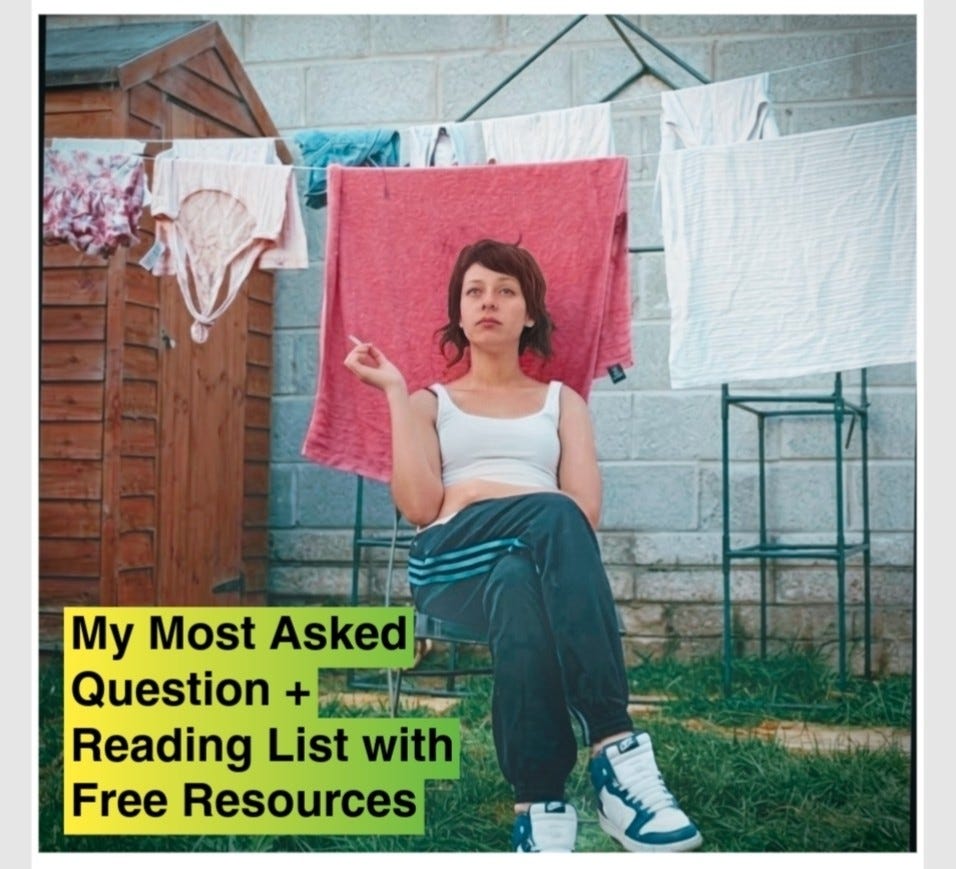
My Most Asked Question + Reading List with Free Resources

Where does Class Therapy Sit?
(My Most Asked Question)
The other day I was drinking coffee, succumbing to the old doom scroll. And honestly, reels are wild, not only for dilly-dallying instead of writing, but also for sharpening the counter-ethos in ways academia could only dream of.
One therapist popped up, railing against therapy that names systems, saying something like:
“Psychology is for the individual… You’ve got people needing to change and the therapist is there unionising the client’s nervous system and playing them a mindfulness tape that’s literally just a theatre kid whispering alienation over and over again to a lo-fi techno beat.”
Or summat along those lines.
And it got me thinking about rigid categories and how little they’ve ever meant to me. I’ve never been one to rigidly define myself — and I definitely don’t define others — because to me it feels like pinning butterflies to a corkboard: lifeless, harsh, and nothing like the real thing.
I don’t like branding, aesthetics, any of that. It’s never felt congruent. It flattens people into one dimension. And for working-class people especially, I reckon it’s instinctual — this refusal to be commodified, to be squeezed into a neat little box, to be held up as a symbol for whatever the world needs that week. A lot of us get deep satisfaction from slipping out of their hands and living beyond expectations.
In my writing I’m not fussy; I make no claims to expertise, only to learning, and writing about myself makes me cringe anyway. Luckily Class Therapy is bigger than me and my ideas. It’s ever evolving organic and includes all of you.
The Lineage Question
People ask me a lot — Where do I, or Class Therapy, actually sit?
And they don’t ask to box us in, but because they feel something in the work and want to know where its roots are.
So is CT:
• individual work?
• collective work?
• personal?
• political?
• art?
• sociology with hilarious jokes?
• community psychology with coffee stains?
• philosophy while Basshunter plays in the background?
The honest answer is: Yes. Yes all of it.
I’m a Straddler
Not in the political-centrist “both sides have a point” way. I’m left — obvs — but critical of the left when it’s all high-fives and forgetting people.
I mean straddling in the working-class way: the way life forces you to live in multiple realities at once; the way survival teaches you to hold nuance without collapsing; the way you need a massive kaleidoscope because the world never, ever shapes itself neatly for people like us.
So if therapy is ever going to have a working-class reckoning — if we’re going to flick the chip off its shoulder that does harm — then we have to bring in multiple disciplines and multiple angles and multiple forms of truth to build a proper CT kaleidoscope.
Which is conveniently canny, because working-class people naturally shine at this.
We’ve straddled perspectives all our lives:
the personal and the political,
the inner and the outer,
the self and the system.
Class Therapy sits exactly in the friction where those worlds collide. The relational seam, the seam that zooms out to understand instead of centring the therapist, the messy, embodied, culturally-loaded place nobody wants to acknowledge because you can’t fit it onto Instagram slides, no matter how many times I try. (Apologies to everyone who follows me without 20/20 vision.)
Individual vs Collective Isn’t a Real Divide
Therapy, as we mostly, know it holds hands with individualism — the Thatcher kind, the kind that stripped communities bare and told us everything was our fault and society didn’t exist.
When therapy ignores systems, it ends up blaming people for falling into a river with a powerful current. But when we treat people purely as representatives of a group — they stop being human and turn into metaphors. Which is equally violent.
Therapy that ignores the individual treats people like symbols, not humans trying to get through a dark patch without a torch. Class Therapy tries to honour both, because multiple realities shape us and contain us.
Your nervous system and your neighbourhood co-author your life.
Your agency and your conditions hold each other by the collar.
Your instincts are yours, but they’re also inherited, shaped, pressured, sharpened.
This is why I build things like Soft Strings, Amber Moments, Counter-Ethos — as relational maps, ways of understanding how people survive and connect and make sense and stay human under pressure.
My work comes from the tension, from the grey, from the unruly part of life where neat theories go to die and survival is seen and validated.
People like binaries because they feel manageable.
But class isn’t tidy.
Trauma isn’t tidy.
Survival definitely isn’t tidy.
And I’m from Teesside, mate I go out without a coat and I’m not afraid to get my hands dirty.
A Note Before the Reading List
My work didn’t start in a library. It started in lived experience — in everyday working-class life, in cities and towns and between bus stops and corner shops.
The work is relational because I’m relational.
I love listening to people telling their stories, the laughing, the crying, the ranting. Talking to strangers in the high street
“Yes! Please do tell me about your rude daughter-in-law, Mildred babe, I’m listening,”
And I’ve been lucky I’ve met people whose fire lit something in me simply through the way they tell stories, without even meaning to. That kind of spark that stays forever, changes you and builds a legacy deeper than any theorist.
My sweet spot is relational ethics, what comes from client work, inner work, and standing knee-deep in the friction that working-class life throws at us.
Everything I write begins there. It’s a working-class methodology, now I think about it.
Class Therapy ideas are born in the shapes people make, in the stories that don’t fit, in the ways working-class people keep each other alive long before a therapist ever turns up.
CT is methodology first.
I don’t have a wall of degrees. I’ve got eyes, ears, curiosity, community, subversive playfulness, and the emotional archaeology of growing up where me and my mates did.
Books help me name what I already know but they’re expensive, require non-dyslexic eyes, and require time, energy and presence.
The work didn’t start with theory. It started with people.
And to you, friend, please don’t ever think not affording a library or means you don’t get a say. Naming, resisting, creating, connecting — that’s ours. Ideas don’t die just because we lack resources, they find another doorway. We’ve always expressed ourselves with courage over outsourcing. The world needs our voices.
The CT Reading List
And before we get into the reading list itself, let me say this:
I’m not pretending this is definitive, or perfect, or academically tidy. It’s just the constellation of thinkers whose work has helped me name things I’ve witnessed.
If I’ve forgotten someone, forgive us, also tech isn’t my strong suit. I’ve added free links where I can because ideas shouldn’t hide behind paywalls or privilege. I hope they all open for you; if they don’t, shout me.
And if there’s someone you think belongs here — someone whose writing speaks to working-class life, safety, survival, humour, or resistance — please share them.
Class Therapy has always been a conversation,
Culture & Atmosphere
Mark Fisher – Capitalist Realism Names the emotional architecture of capitalism with painful accuracy. People sometimes say CT is carrying on Fisher’s Legacy I take this as a responsibility more than a compliment. It’s a reminder that the climate he wrote about hasn’t gone anywhere.
Read free Copy-paste URL: https://archive.org/details/mark-fisher-capitalist-realism-is-there-no-alte-book-zz.org
Stuart Hall – Essential Essays (and archive) Explains culture without flattening people; identity as weather, class as atmosphere.
Archive access Copy-paste URL: https://stuarthallarchive.bham.ac.uk/resources-and-links
Raymond Williams – Culture and Society, 1780–1950 “Structures of feeling” as emotional aspects of class life.
Read free Copy-paste URL: https://archive.org/details/culturesociety17800will
Paul Gilroy – Postcolonial Melancholia. Grief and collective survival.
Read free Copy-paste URL: https://archive.org/details/postcolonial-melancholia
Trauma & Survival
Judith Herman – Trauma and Recovery, Roots trauma in reality and power, not performance.
Read free Copy-paste URL: https://archive.org/details/traumaandrecover00herm
Frantz Fanon – The Wretched of the Earth, Shows how power enters the body; wounds are political before they’re personal.
Read free Copy-paste URL: https://archive.org/details/wretchedofearth00fano
Audre Lorde – Truth with surgical precision and startling warmth.
Read free Copy-paste URL: https://archive.org/details/sisteroutsideres0000lord
bell hooks – All About Love Treats love as an ethic; threads care, accountability, and survival together.
Read free Copy-paste URL: https://archive.org/details/allaboutlovenewv00hook
Working-Class Life
E.P. Thompson – The Making of the English Working Class Writes ordinary people back into history.
Read free Copy-paste URL: https://archive.org/details/makingofenglishw0000thom
Lisa McKenzie – Getting By Honest, unfiltered, unpretentious.
Read free Copy-paste URL: https://archive.org/details/getting-by
Carolyn Steedman – Landscape for a Good Woman Girlhood, shame, longing.
Read free Copy-paste URL: https://archive.org/details/landscapeforgood00stee
Mass Observation Archive Ordinary life recorded without agenda.
Explore free Copy-paste URL: https://www.massobservationproject.amdigital.co.uk/
Care & Mutual Aid
Dean Spade – Mutual Aid Care as practice; mutual aid that means something.
Read free Copy-paste URL: https://www.deanspade.net/wp-content/uploads/2020/10/Mutual_Aid_Final.pdf
Sara Ahmed – Complaint! Maps how emotions move through institutions; shame, anger, belonging as social forces.
Read free Copy-paste URL: https://archive.org/details/complaint_202110
Tithi Bhattacharya (ed.) – Social Reproduction Theory Links care, labour, and survival.
Read free Copy-paste URL: https://archive.org/details/socialreproductiontheoryremappingclassrecenteringoppression
Barbara Ehrenreich – Bright-Sided Critique of wellness and positive thinking.
Read free Copy-paste URL: https://archive.org/details/brightsidedhowre00ehre
Power & Resistance
Antonio Gramsci – Selections from the Prison Notebooks Hegemony, culture, and resistance.
Read free Copy-paste URL: https://archive.org/details/selectionsfrompr0000gram
Pierre Bourdieu – Distinction Habitus and taste as classed survival logic.
Read free Copy-paste URL: https://archive.org/details/distinctionasoci00bour
James Baldwin – The Fire Next Time Rage, dignity, and systemic harm.
Read free Copy-paste URL: https://archive.org/details/firenexttime0000bald
Paulo Freire – Pedagogy of the Oppressed Education as liberation; dialogue as survival.
Read free Copy-paste URL: https://archive.org/details/pedagogyofoppres0000frei
Keeanga-Yamahtta Taylor – Race for Profit Housing, race, and class precarity.
Read free Copy-paste URL: https://archive.org/details/raceforprofit
Ethics & Therapy Critique
Gillian Proctor – Values and Ethics in Counselling and Psychotherapy Challenges neutrality, centres relational ethics.
Read free Copy-paste URL: https://archive.org/details/valuesethicsinco0000proc
And finally, a little dream I’ve been brewing, I’m hoping to set up a free travelling library through Instagram. A free, slow, communal, pass-it-on kind of thing, where books wander between us and gather notes in the margins like little letters from the wider neighbourhood. If that sounds like something you’d use, I’d love your thoughts.
Class Therapy has always lived in the spaces between us — and I want books as accurate reflections to live there too.
With love and grit,
Always,
Nell x
Class reading list! Thank you.
Love u Nell 🌸